The Astrology Equivalent of a Celtic Cross: When Major Life Changes Are Written in the Chart
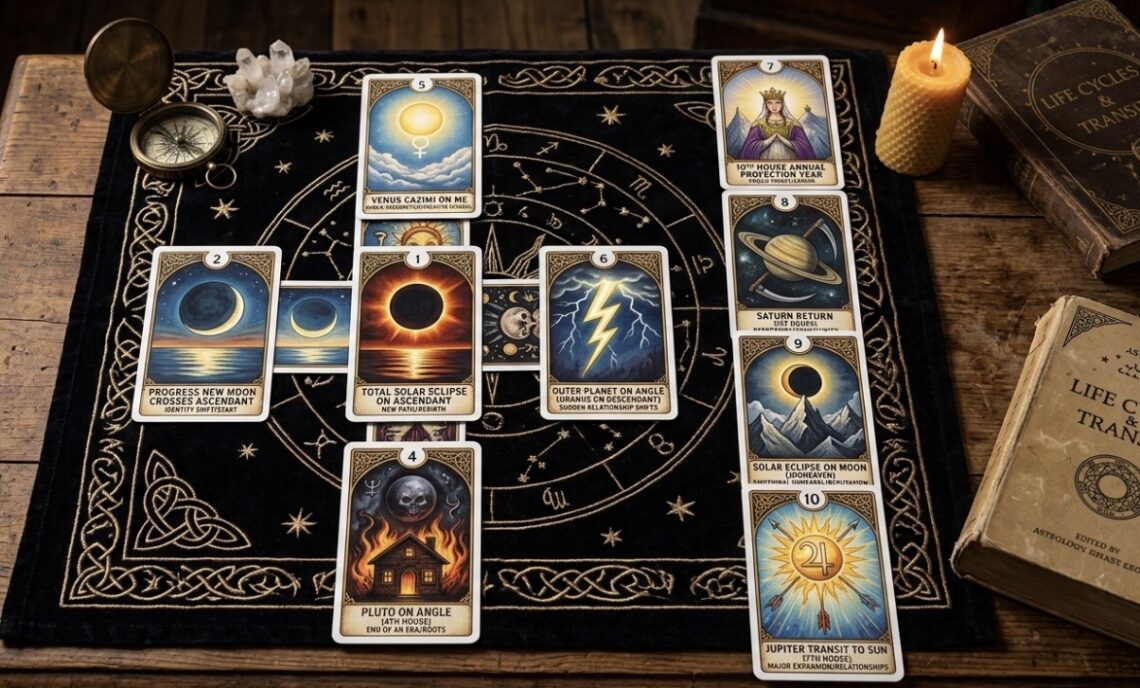
In tarot, one of the most famous spreads is the Celtic Cross. A reader lays down ten cards, with each position representing a different part of the story: the present situation, challenges, past influences, future developments, hopes, fears, and possible outcomes.
A powerful Celtic Cross spread is not necessarily one where every card is “good” or “bad.” What makes it significant is that the cards appear to tell the same story from different angles.
Astrology works in a similar way — but there is no exact equivalent of pulling ten tarot cards.
Astrology does not require ten different events to happen at once for something important to occur. Sometimes one major transit can coincide with a major life event. However, the most significant turning points often happen when several different astrological cycles begin telling the same story.
Think of it as multiple clocks in the sky pointing toward the same chapter of life.
So What Is the Astrology Equivalent of a Celtic Cross?
Lets say you are asked to pull cards for a Celtic Cross, and you pull many Major Arcana cards. This would not translate into “ten major transits.”
It would be closer to a period where several major astrological symbols are activated together.
Perhaps:
- a Pluto transit to an angle
- an eclipse on a luminary
- a progressed cycle beginning
- Jupiter activating a key point
- a major profection year
- a solar return repeating the theme
The power comes from the repetition.
Astrology does not need every card in the deck.
It needs enough symbols to tell the same story.
Celtic Cross where all ten cards are Major Arcana It would be something like:
- Pluto exactly hitting an angle,
- an eclipse hitting a luminary,
- Jupiter hitting the MC or Sun,
- a progressed lunation beginning,
- a major profection,
- a solar return repeating the same themes, Within a tight window like 6–18 month period.
- 18 months does not feel excessive to me is because eclipses themselves come in families, progressed lunations unfold slowly, and outer planets on an angle or conjunct natal planets is not a single-day event.
The Major Turning Points to Watch
Outer Planet Transits: The Big Life Chapters
The slow-moving planets often describe periods when life cannot remain the same.
Saturn can bring:
- responsibility
- maturity
- endings and commitments
- career restructuring
- confronting reality
A Saturn return is one of the most famous examples, occurring approximately every 29 years.
But Saturn can also be especially significant when it contacts:
- the Sun (identity and purpose)
- Moon (emotional foundations)
- Ascendant (identity and direction)
- Midheaven (career and public life)
Uranus can bring:
- sudden changes
- breakthroughs
- liberation
- unexpected opportunities
Neptune can dissolve old structures, changing dreams, beliefs, and perceptions.
Pluto often represents deep transformation, especially when it contacts:
- the Sun
- Moon
- Ascendant
- Midheaven
- IC
Pluto activating an angle of the chart can feel like an entire life chapter is being rewritten.
Eclipses: The Turning Points
Eclipses are often associated with major transitions, especially when they contact important natal points.
An eclipse on:
- the Sun can coincide with changes in identity, purpose, confidence, or visibility.
- the Moon can coincide with emotional, family, or inner-life changes.
- the Ascendant or Descendant can coincide with changes in identity, relationships, and how others perceive you.
- the Midheaven or IC can coincide with career, home, family, or life-direction shifts.
Eclipses repeat in cycles. The same eclipse family can return approximately every 18 years, often revisiting similar themes.
Nodal Returns and Nodal Transits: Fated Turning Points
The Lunar Nodes aren’t planets—they are points where the Moon’s orbit crosses the Sun’s apparent path. Yet many astrologers consider them among the most significant timing indicators in a chart.
Approximately every 18.6 years, the transiting North and South Nodes return to their natal positions, beginning a new nodal cycle. These periods often coincide with major crossroads, where old chapters close and new directions emerge.
Other important nodal activations include:
● The Nodal Return (every ~18.6 years): A period of realignment with long-term goals, purpose, relationships, and life direction.
● The Nodal Opposition (around age 9, 27–28, 46–47, 64–65): Often brings decisions, course corrections, and a reassessment of the path you’re on.
● Eclipses on the Natal Nodes: Because eclipses occur near the lunar nodes, they can amplify nodal themes, particularly when they also activate your Sun, Moon, Ascendant, Midheaven, or other key natal planets.
● Major Planetary Conjunctions to the Nodes: When slower planets—particularly Jupiter, Saturn, Uranus, Neptune, or Pluto—conjunct your natal North or South Node, they can mark periods where significant opportunities, responsibilities, endings, or transformations seem to align with a larger life story.
On their own, nodal transits don’t guarantee dramatic events. However, when they coincide with other major timing techniques—such as eclipses, progressions, annual profections, solar returns, or outer-planet transits—they often become part of a much larger turning point.
Progressions: The Inner Timeline
Progressions show internal development and personal evolution.
Some especially important ones are:
Progressed New Moon
- A new approximately 29-year personal cycle begins.
- It can represent a major reset in direction, identity, and purpose.
Progressed Moon changing signs or houses
- The progressed Moon changes signs roughly every 2–2.5 years.
- It crosses the Ascendant approximately every 28 years.
- These periods can correspond with emotional shifts, new beginnings, and changes in how someone experiences themselves.
When a progressed Moon or progressed New Moon activates the Sun or an angle, astrologers often pay close attention.
Jupiter: Growth and Opportunity
Jupiter returns approximately every 12 years.
Important Jupiter contacts include:
- Jupiter conjunct the Sun
- Jupiter conjunct the Ascendant
- Jupiter conjunct the Midheaven
- Jupiter activating the chart ruler
- Jupiter activating the North Node
Jupiter does not guarantee a specific outcome, but it often coincides with periods of expansion, opportunity, growth, or increased visibility.
Venus Retrograde and Venus Cazimi
Not every retrograde is equally personal.
Venus retrograde becomes especially significant when it contacts:
- the Sun
- Moon
- Ascendant
- Midheaven
- natal Venus
- personal planets
A Venus cazimi — when Venus is exactly conjunct the Sun — is a particularly concentrated Venus moment.
When this happens over a natal planet or angle, it can symbolically represent a period of deep reassessment around:
- relationships
- values
- creativity
- money
- self-worth
Annual Profections and Solar Returns
Annual profections highlight a different life area each year.
Every 12 years, the same house becomes activated again.
A 10th-house profection year may highlight:
- career
- reputation
- achievements
- public visibility
An 11th-house profection year may highlight:
- audiences
- communities
- networks
- long-term goals
Solar returns add another layer by describing the atmosphere of the year ahead.
The Rule of Three: Why One Transit Is Rarely Enough
Astrologers often look for repetition.
One indicator can be meaningful.
Two indicators can be interesting.
Three or more indicators pointing toward the same theme create a much stronger pattern.
For example:
- An eclipse on the Sun
- Saturn conjunct the Sun
- Jupiter conjunct the Midheaven
would be much more significant than any one of those alone.
For a truly major life chapter, you often see several factors repeating the same message:
- an outer planet transit
- an eclipse
- a progression
- a profection year
- a solar return emphasis
Not every major event needs ten indicators. Life-changing moments can happen with only a few powerful activations.